Haha that sounded corny as a title so I decided to keep it.
Right now, I'm still on-campus and on my way home. Apparently the cable guy was there and messed up the Internet and therefore I will not have a hefty post until a day or two. I did read about Gillian Wearing through Wikipedia and the other class blogs and she seems interesting. She reminds of the man who does the "PostSecret" exhibitions and books. I believe it was Frank Warren who collects all these postcards from people. I think that's a cool concept where you can be artistic and truthful at the same time.
I remember an exhibit here at the FAB gallery awhile ago where the artist had large transparent curtains hanging from the ceiling in the room. In each curtain, were a bunch of little pockets and next to the display was a podium with leaves and pens. We were all invited to participate and discuss someone or something that we miss. Some of the responses I read were funny and I guess I was feeling somber that day because I wrote something sad.
Still, it was a great work and it was interesting to see who would participate if any. Also, if people look away when they write their true emotions is intriguing as well.
Food for thought, eh?
Monday, November 26, 2007

Tuesday, November 20, 2007
What can be done?
I, too, get extremely sad when AIDS is brought up, especially in reference to those countries suffering from it in Africa. It is truly heartbreaking to see those specials on television that feature broken and dying families. I think the saddest part of it all is in relation to the children. I have heard that so many adults have died of the disease, that whole villages are nothing but children. :(
This brings me to the chapter, which had much to say about the topic of AIDS and the many misconceptions or myths that were made up about it. I wasn't around when AIDS was first discovered, but it was not all that long ago. The text tells of how it was first noticed in homosexual men and how that factor contributed to the association with homosexuals to the disease. Many non-scientific assumptions were made, such as AIDS being able to casually travel from person to person. This was such an accepted belief that when some gay activists were being arrested, policemen wore yellow gloves to 'protect' themselves from their 'AIDS.'
It is interested that you brought Torrez up, Asma, as his project involving the candy goes along EXACTLY with this chapter. The artist's stack of chocolate questioned the viewer whether or not he would take a piece of candy from a gay man, all the way up to a kiss. It was a very interesting concept, and I can see why he came up with such an idea, as people during his time thought that he would infect them just by being friendly, or even, shall I say, just being human.
This brings me to the chapter, which had much to say about the topic of AIDS and the many misconceptions or myths that were made up about it. I wasn't around when AIDS was first discovered, but it was not all that long ago. The text tells of how it was first noticed in homosexual men and how that factor contributed to the association with homosexuals to the disease. Many non-scientific assumptions were made, such as AIDS being able to casually travel from person to person. This was such an accepted belief that when some gay activists were being arrested, policemen wore yellow gloves to 'protect' themselves from their 'AIDS.'
It is interested that you brought Torrez up, Asma, as his project involving the candy goes along EXACTLY with this chapter. The artist's stack of chocolate questioned the viewer whether or not he would take a piece of candy from a gay man, all the way up to a kiss. It was a very interesting concept, and I can see why he came up with such an idea, as people during his time thought that he would infect them just by being friendly, or even, shall I say, just being human.
Monday, November 19, 2007
I need to wake up.


Whenever I hear or read about AIDS, I get extremely sad. It's a problem that won't seem to go away. Also, it's important to realize that anyone is vulnerable to getting AIDS and it's not because of the stereotypes society has placed on gays and dirty needles. Also, I get reminded of the AIDS blanket as well as works from Felix Gonzalez-Torres.
It's also important to understand that AIDS has existed for a long time and people die all over the world from it. The problem is not only in countries with extreme poverty, which cannot afford the proper medication and it is important to care.
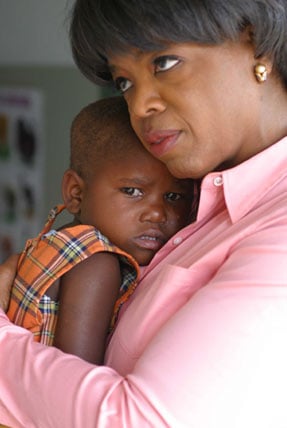 One activist and humanist that I fully adore and support is Oprah Winfrey. It is like the world relies on her to make a difference and to spread the message to others. If you ever get a chance, go watch her 20th Anniversary DVD Collection, it will make you cry!
Someday, if I have the resources to travel, I will try to do some humanitarian work and volunteer my time to those who need it most. It's just like that Melissa Etheridge song, "I Need to Wake Up" featured at the end of the film, An Inconvenient Truth and so far with this semester, that's what I've been trying to do.
I need to wake up. I need others to wake up. But exactly how?
I'm still trying to refine my final project. I feel like there are so many issues I want to address at once and it's a little overwhelming. I'm definitely considering the impact of the two works I had mentioned above.
CFL tree + then back to the readings
 So how did everyone enjoy The Sustainability Project last week?
If there are still petition pages, please hand them over to me so I can keep them all in one folder for safekeeping, especially away from the rain!
From what I glanced at, our station by the tree had close to 70 signatures! I'm so proud of everyone involved. I'm going to print out more copies and spread the word during my classes. I'll have copies also to hand out during our ASA class if anyone wants to help out.
People are still asking about it and I'm happy that they care :) I'll probably light up the CFL later this week, maybe Tues + Thurs, because that's when I have sculpture...so from like 5 to 7 p.m., make sure to check it out! Also, our ArtsBus trip was really cool! I'll find a good photo to post of that as well. Chelsea never disappoints whenever I go! :)

Friday, November 16, 2007
My Own Movement Prejudice
Right now I'm only half way through chapter 7 in The Art of Protest: Acting Up Against AIDS and I can already feel inspired by the ACT UP groups' passion and influence. At the same time I'm thinking about how I would have responded in those times, had I been older than 5 years o ld. Reed is discussing the advantages and disadvantages the group faced. The first disadvantage was that ACT UP was defending a group almost viewed as second-class citizens. The defendants were poor, minorities, gay (or lesbian), protitutes, drug users, you name it they fought for them. I think about the family and community I was raised in, even in the wake of liberal growth, and I wonder if I would have supported ACT UP. AIDS is bad. I learned that as a child, but were the people who got it bad? When the disease was stigmatized as a gay, or druggie, or prostitutes only sickness, I'm almost positive that I would have shunned away from supporters of those people. And I find that I have this attitude with a lot of protestors and movements now. Even things I agree with I walk faster in the opposite direciton. On campus there are booths and people handing out flyers, pamphlets, posters, and unless I force myself to walk up and listen, or I'm participating on my own, do I fully empathize and grasp what's being talked about. Looking up information and pictures on the ACT UP revolution, I know that they were hard to avoid. I think that, in that, there is art and inspiration.
 I'm in a bind with the ACT UP methods however, like I or anybody could be with interpretation of art or organizantions' techniques. For something to reach me, and most people, it has to steal my attention, hold it, and make me think. Sometimes I need to be offended, or shocked, or sadded, or sickened, or so made to laugh. I need to be able to talk about it later, in a good way or a bad way. And while these things are necessary I can see how too much of something can turn people away. ACT UP targeted and probably embarrassed, insulted, and pissed off a lot of people. I'm glad they did this. It got attention and if bad publicity is still good publicity than its mission was accomplished regardless, but I can't help but think that maybe they would have gotten politcal, FDA, and media flies faster with honey than with vinegar. For some causes I see how you could get over one groups feelings for another cause's success. World hunger, war, and yes AIDS, need to be attacked but at the same time full force without balance can come back to bite you in butt. Immediate reward does not always equal long run gratification. And I think movements, and art, need to be eternal.
 ld. Reed is discussing the advantages and disadvantages the group faced. The first disadvantage was that ACT UP was defending a group almost viewed as second-class citizens. The defendants were poor, minorities, gay (or lesbian), protitutes, drug users, you name it they fought for them. I think about the family and community I was raised in, even in the wake of liberal growth, and I wonder if I would have supported ACT UP. AIDS is bad. I learned that as a child, but were the people who got it bad? When the disease was stigmatized as a gay, or druggie, or prostitutes only sickness, I'm almost positive that I would have shunned away from supporters of those people. And I find that I have this attitude with a lot of protestors and movements now. Even things I agree with I walk faster in the opposite direciton. On campus there are booths and people handing out flyers, pamphlets, posters, and unless I force myself to walk up and listen, or I'm participating on my own, do I fully empathize and grasp what's being talked about. Looking up information and pictures on the ACT UP revolution, I know that they were hard to avoid. I think that, in that, there is art and inspiration.
Now further along in the chapter the semantics impact on AIDS brings on a new insight. There are certain words that will always make a divide in social relationships whether it is with one person or a whole group. Racial slurs (that need not be named), AIDS or HIV, homosexual, poor, alcoholic, all words except maybe prepositions are "infected with cultural assumptions" that affect how you feel about something automatically. Its as if there's a button that is pushed when some words are said. Our brain biologically recognizes the words and places them in the boxes they belong: immoral, funny, disgusting, acceptable. And from there relationships can change in one second. I think the same applies to images and groups of people. ACT UP alone (through the images I've seen) was on its own a formiddable "culturually infected" group that when mentioned (I'm sure at the time) or watched changed how someone felt whether in a postive or negative way.
 I'm in a bind with the ACT UP methods however, like I or anybody could be with interpretation of art or organizantions' techniques. For something to reach me, and most people, it has to steal my attention, hold it, and make me think. Sometimes I need to be offended, or shocked, or sadded, or sickened, or so made to laugh. I need to be able to talk about it later, in a good way or a bad way. And while these things are necessary I can see how too much of something can turn people away. ACT UP targeted and probably embarrassed, insulted, and pissed off a lot of people. I'm glad they did this. It got attention and if bad publicity is still good publicity than its mission was accomplished regardless, but I can't help but think that maybe they would have gotten politcal, FDA, and media flies faster with honey than with vinegar. For some causes I see how you could get over one groups feelings for another cause's success. World hunger, war, and yes AIDS, need to be attacked but at the same time full force without balance can come back to bite you in butt. Immediate reward does not always equal long run gratification. And I think movements, and art, need to be eternal.
But in the end cultural infection is change and adaptation. Communities, goals, ideas, and beliefs change as much as the AIDS virus and only new forms of medicine and methods will succeed in healing our differences and the disease.
Tuesday, November 13, 2007
Woooah...Rikrit is pretty awe-some :D
I have been writing about the other text a lot lately, so I think it's time to switch it up and share my thoughts on "In the Making." This week's article about Rikrit Tiravanija was so interesting. I'm not sure I quite understood everything about this artist's creations, but I did think they were pretty cool. This artist worked with familiar, everyday activities (p.102) such as sharing a meal. He would set up an exhibit in a museum, and leave food or maybe just ingredients to entice people to sit, eat, and talk. This was most interesting as the article mentioned that such things are not allowed in a museum. It was also mentioned in reference to the exhibit that the silverware made available to his subjects was disposable. Rikrit said this is because he did not want normal people to be intimidated by his works; he didn't want them to feel it was too sophisticated for them. I also liked the fact that Rikrit was not pressured into producing new work; it was mentioned that he ran the same exhibit for three years.
However, the dining setup was not the only exhibit of its kind from Rikrit. He also had an exhibit featuring people living in the museum. People were encouraged to eat, sleep, and possibly even bath inside the museum. It was a nice thought, but it made the museum remain open 24 hours a day, which is certainly not a normal practice. I also found it interesting that Rikrit cared little whether his exhibit was ruined by his subjects. He seemed not to care about rules or consequences. Rikrit has reproduced these exhibits in many major cities and has broken many barriers in the art world in doing so.
However, the dining setup was not the only exhibit of its kind from Rikrit. He also had an exhibit featuring people living in the museum. People were encouraged to eat, sleep, and possibly even bath inside the museum. It was a nice thought, but it made the museum remain open 24 hours a day, which is certainly not a normal practice. I also found it interesting that Rikrit cared little whether his exhibit was ruined by his subjects. He seemed not to care about rules or consequences. Rikrit has reproduced these exhibits in many major cities and has broken many barriers in the art world in doing so.
Monday, November 12, 2007
GREEN WEEK!
Facebook Group: The Sustainability Project
GREEN WEEK
Everyone should join!
Who: The Sustainability Project Group - Fall 2007
What: Get a green dot. Stamp your pride. Sign the petition. Light the tree! :)
When: November 12th - 15th
Where: Everywhere! (Mostly Fairfax, Va.)
Why: We need to be eco-friendly!
President Merten Commits to 'Climate Neutral' Campus - The Mason Gazette - August 20, 2007
Going Green Gets Easier at Mason - The Mason Gazette - October 8, 2007
GREEN WEEK
Everyone should join!
Who: The Sustainability Project Group - Fall 2007
What: Get a green dot. Stamp your pride. Sign the petition. Light the tree! :)
When: November 12th - 15th
Where: Everywhere! (Mostly Fairfax, Va.)
Why: We need to be eco-friendly!
President Merten Commits to 'Climate Neutral' Campus - The Mason Gazette - August 20, 2007
Going Green Gets Easier at Mason - The Mason Gazette - October 8, 2007
Wednesday, November 7, 2007
Reading rainbow
I just realized that I wrote about Tiravanija instead of Daniel Martinez for my last post. Oh well, I guess I will discuss him for the post due next week!
Hopefully people will see this:
The Sustainability Project 2007
November 12-16
Go green dots!
Hopefully people will see this:
The Sustainability Project 2007
November 12-16
Go green dots!
Tuesday, November 6, 2007
Free dinners to free citizenship
From In the Making, I enjoyed reading about Rikrit Tiravanija because I vaguely remember an artist who made a personal space within a gallery. From what I remember, the artist was interacting with the viewers and engaging in dialogue. The concept of free food, beds and music studios is interesting because I think these services should be free to the general public. Not only for those down on their luck, but also to create an inviting atmosphere and to make friends among strangers.
Although Tiravanija works appear endearing, I cannot help comparing him to other performance artists like Vito Acconci and his controversial work, Seedbed. Is Tiravanija simply creating a quaint atmosphere? Or is he being too passive by waiting for his audience to visit rather to reach out beyond the confines of a gallery space? I am brought to this questioning based on the text, which reads: "he capitalizes on the liberty granted to artists to be non-conformists and explore zones outside the normal matrix of art and culture." By continuing to read the text, I felt relieved with the 1996 piece in the forest with the bicycle and tableware.
I felt as though the piles of leftover food were effective and played on the viewer's perception of sight and smell. By reading his interview responses, it is almost like the artist randomly chooses the performance pieces, similar to a light's on-off switch. I am curious to this approach and question whether it is conceptual enough. Besides verbal dialogue and providing some Thai food, I don't feel like the artist "owns" the piece enough. Maybe I would suggest he create some of the pieces used or that he uses items he has collected through his travels? Just a thought.
With the chapter on immigration and the Chicano culture, The Art of Protest discusses the community formed from "la familia." Personally, I see the culture as hardworking and misunderstood. I know that there are legalities behind everything, but I feel as though Mexicans have done a lot for our country despite being a legal citizen or not. I keep on flash backing to moments on the news when I see Cubans floating on rafts in hope of obtaining a better opportunity.
For a country that provides so much and attempts to embrace all, I feel like immigration is a tough issue. Many Hispanics take on jobs that many Americans choose not to do, and they do it well. Now, I find that endearing. There should a process for illegal immigrants to obtain citizenship and residency in the U.S. by stating their benefit (economic career) to the country and to pledge allegiance like other citizens do. Why push out people? I mean, we all came from somewhere a long time ago.
This is a bad joke I heard awhile ago but I think it may have been from Jay Leno:
"In order to stop illegal immigrants from coming in, President Bush wants to build a 370-mile wall along the border between the U.S. and Mexico. Do you know who is going to build it? The Mexicans."
Although Tiravanija works appear endearing, I cannot help comparing him to other performance artists like Vito Acconci and his controversial work, Seedbed. Is Tiravanija simply creating a quaint atmosphere? Or is he being too passive by waiting for his audience to visit rather to reach out beyond the confines of a gallery space? I am brought to this questioning based on the text, which reads: "he capitalizes on the liberty granted to artists to be non-conformists and explore zones outside the normal matrix of art and culture." By continuing to read the text, I felt relieved with the 1996 piece in the forest with the bicycle and tableware.
I felt as though the piles of leftover food were effective and played on the viewer's perception of sight and smell. By reading his interview responses, it is almost like the artist randomly chooses the performance pieces, similar to a light's on-off switch. I am curious to this approach and question whether it is conceptual enough. Besides verbal dialogue and providing some Thai food, I don't feel like the artist "owns" the piece enough. Maybe I would suggest he create some of the pieces used or that he uses items he has collected through his travels? Just a thought.
With the chapter on immigration and the Chicano culture, The Art of Protest discusses the community formed from "la familia." Personally, I see the culture as hardworking and misunderstood. I know that there are legalities behind everything, but I feel as though Mexicans have done a lot for our country despite being a legal citizen or not. I keep on flash backing to moments on the news when I see Cubans floating on rafts in hope of obtaining a better opportunity.
For a country that provides so much and attempts to embrace all, I feel like immigration is a tough issue. Many Hispanics take on jobs that many Americans choose not to do, and they do it well. Now, I find that endearing. There should a process for illegal immigrants to obtain citizenship and residency in the U.S. by stating their benefit (economic career) to the country and to pledge allegiance like other citizens do. Why push out people? I mean, we all came from somewhere a long time ago.
This is a bad joke I heard awhile ago but I think it may have been from Jay Leno:
"In order to stop illegal immigrants from coming in, President Bush wants to build a 370-mile wall along the border between the U.S. and Mexico. Do you know who is going to build it? The Mexicans."
Sunday, November 4, 2007
I've learned something new AND made some connections!!!
Chapter 4 in "The Art of Protest" brought forth a lot of new information to me, almost too much at once. I had always wondered what else was going on during the the time of segregation and protest. The African-Americans were not the only minority being discriminated against, but I had heard little or no information on the subject. This chapter offered a wealth of information about the discrimination of the Chicanos/as.
The most interesting bits that I took away from the chapter were the many connections between this movement and Civil Rights movement. Several areas of the text made allusions to the similarities between the two.
An important aspect of the Chicano/a movement was its integration of art. The three Mexican muralists that had the biggest effect on the movement, "three greats", were Diego Rivera, Jose Clemente Orozco, and David Alfaro Siquieros. I had heard previously of Rivera and Orozco, as we studied them in Unit 3 of NCC's First Year, but I never really made the connection between them and this movement. Pulqueria art, or art that featured landscapes and familiar scenes was also mentioned in the text and connected with the Civil Rights movement.
"Just as the adaption of the black church music for the purposes of the civil rights movement allowed a radical new content to enter through a familiar, nonthreatening mode, the existence of pulqueria art probably lessened the shock of the radical new messages being conveyed by community murals." (p. 106)
The next connection was the inclusion of faith in both movements and how it was integral.
"And when they marched, the UFW members carried a statue of the Virgen de Guadeloupe, patron saint of the Mexican poor, thus linking the Catholic faith of the majority of the union members to the struggle, as black Christianity helped form a base for the civil rights movement." (p. 109)
There were also similarities between the leaders. the strategies, the groups, and the nationalism of the two movements.
"The nonviolent strategies of King and Chavez, for example, exist unproblematically alongside the armed struggle represented by the Mexican revolutionaries, the Black Panthers, and the Tijerina. And while the overall image was surely intended to evoke an emerging chicanismo, a Chicano nationalism similar to the black nationalism discussed in chapter 2, none of the pictured individuals, including the temporary ones, were full supporters of a nationalist position." (p. 111)
Another connection was made between the Black Panthers and a Chicano group called the Brown Berets.
"California was also home to one of the most radical, paramilitary groups in the movement, the Brown Berets, a group with many similarities to the Black Panthers that protested police brutality in the barrios and often provided security for marches and rallies." (p. 112)
Lastly, both movements had connections to the colonization, or anti colonization, of their countries of origin.
"Just as the black movement drew strength from the image of anti colonial struggles in Africa, Chicanos drew special inspiration from the struggles in the Spanish-speaking countries of South America against European and U.S. colonialism. (p. 113)
I found this chapter very informative and interesting, but could not help but wonder why these movements did not join together as they had a similar cause. As they say, there is strength in numbers. However, there may have been some overlap, here and there, it just may not have been discussed in this section.
The most interesting bits that I took away from the chapter were the many connections between this movement and Civil Rights movement. Several areas of the text made allusions to the similarities between the two.
An important aspect of the Chicano/a movement was its integration of art. The three Mexican muralists that had the biggest effect on the movement, "three greats", were Diego Rivera, Jose Clemente Orozco, and David Alfaro Siquieros. I had heard previously of Rivera and Orozco, as we studied them in Unit 3 of NCC's First Year, but I never really made the connection between them and this movement. Pulqueria art, or art that featured landscapes and familiar scenes was also mentioned in the text and connected with the Civil Rights movement.
"Just as the adaption of the black church music for the purposes of the civil rights movement allowed a radical new content to enter through a familiar, nonthreatening mode, the existence of pulqueria art probably lessened the shock of the radical new messages being conveyed by community murals." (p. 106)
The next connection was the inclusion of faith in both movements and how it was integral.
"And when they marched, the UFW members carried a statue of the Virgen de Guadeloupe, patron saint of the Mexican poor, thus linking the Catholic faith of the majority of the union members to the struggle, as black Christianity helped form a base for the civil rights movement." (p. 109)
There were also similarities between the leaders. the strategies, the groups, and the nationalism of the two movements.
"The nonviolent strategies of King and Chavez, for example, exist unproblematically alongside the armed struggle represented by the Mexican revolutionaries, the Black Panthers, and the Tijerina. And while the overall image was surely intended to evoke an emerging chicanismo, a Chicano nationalism similar to the black nationalism discussed in chapter 2, none of the pictured individuals, including the temporary ones, were full supporters of a nationalist position." (p. 111)
Another connection was made between the Black Panthers and a Chicano group called the Brown Berets.
"California was also home to one of the most radical, paramilitary groups in the movement, the Brown Berets, a group with many similarities to the Black Panthers that protested police brutality in the barrios and often provided security for marches and rallies." (p. 112)
Lastly, both movements had connections to the colonization, or anti colonization, of their countries of origin.
"Just as the black movement drew strength from the image of anti colonial struggles in Africa, Chicanos drew special inspiration from the struggles in the Spanish-speaking countries of South America against European and U.S. colonialism. (p. 113)
I found this chapter very informative and interesting, but could not help but wonder why these movements did not join together as they had a similar cause. As they say, there is strength in numbers. However, there may have been some overlap, here and there, it just may not have been discussed in this section.
Tuesday, October 30, 2007
Coincidental Connection...
I also found the article about Neshat in "In the Making" to be very interesting, but for different reasons than my group members. I don't know if this blog is to be used for discussions from other classes, but, I am going to include them. This article spoke of an artist who had an interest and was a part of the Islamic world, as well as the Western world. Her art medium is film and she uses it to depict images of the Islamic world and its people.
I felt that this article echoed a discussion that occured in my Women and Leadership class. Last Thursday, we had a speaker come talk to us who had lived in several Middle Eastern countries as her husband was in the military. She told us many things about the women of those countries and disproved many misconceptions that the west has about oppression of women in the Middle East. Many women in our country believe that the veil is a very oppressive garment, but according to our speaker, some of the women who were them think differently. The speaker told us how she had interviewed many different women and asked their opinion about many different things, including the veil. Some women didn't even care about the veil, in fact, one even said something along the lines of "It doesn't matter if I wear it, or I don't, it's my decision." The answer I liked the best, though, came from a woman who preferred the veil. She said that she liked that people didn't pay attention to her and that she was free to go about her day without people viewing her body. She also added that women of the west invite others to objectify them by the way that they dress themselves.
I felt these two different viewpoints to be very interesting, and, like Asma, am wondering whether or not Neshat thinks that the veil is oppressive, because I got the impression from the article that maybe she thought it was. And, like Kelsey, I am wondering what her views are of multiculturalism, because she seems to speak of her two worlds as separate, not really combining them, or celebrating them together, or separately. It's somewhat confusing, I think....
I felt that this article echoed a discussion that occured in my Women and Leadership class. Last Thursday, we had a speaker come talk to us who had lived in several Middle Eastern countries as her husband was in the military. She told us many things about the women of those countries and disproved many misconceptions that the west has about oppression of women in the Middle East. Many women in our country believe that the veil is a very oppressive garment, but according to our speaker, some of the women who were them think differently. The speaker told us how she had interviewed many different women and asked their opinion about many different things, including the veil. Some women didn't even care about the veil, in fact, one even said something along the lines of "It doesn't matter if I wear it, or I don't, it's my decision." The answer I liked the best, though, came from a woman who preferred the veil. She said that she liked that people didn't pay attention to her and that she was free to go about her day without people viewing her body. She also added that women of the west invite others to objectify them by the way that they dress themselves.
I felt these two different viewpoints to be very interesting, and, like Asma, am wondering whether or not Neshat thinks that the veil is oppressive, because I got the impression from the article that maybe she thought it was. And, like Kelsey, I am wondering what her views are of multiculturalism, because she seems to speak of her two worlds as separate, not really combining them, or celebrating them together, or separately. It's somewhat confusing, I think....
Monday, October 29, 2007
What Gets Your Attention
"Strangeness captivates viewers" says Shirin Neshat, photographer and film -maker, born in Iran and American citizen.
Usually I don't enjoy the articles from In the Making--the art's too out there and i don't understand the message--but this one was different. The artist represented two different cultures and ideologies, two different ways of life, two different ways to represent her ideas.
I like films because the messages are universal, or at least appeal to a mass audience despite differences. Paintings and drawings can be interpretted in so many different ways depending on the eyes looking at the art work. The lack of differentiation and exclusion in Neshat's work makes you pay more attention because you don't write it off because you don't understand it. At the same time I enjoy that her art incorporates a lot (in some pieces, only inorporates) her heritage.
Coming from a diverse background myself, I like that she's found a way to depict all the aspects of herself, while illustrating that they are opposing but can blend in an artisitic and progressive fashion.
I opened the blog with her quote on how to appeal and grab the attention of her audience. That its the strange things that make a person stop and think. While if I have to think to hard I might get to frustrated to think deeply about something, it is the strange images that remain in my mind.
I do wonder though, if she meant that having two differing cultures is strange
 -maker, born in Iran and American citizen.
Usually I don't enjoy the articles from In the Making--the art's too out there and i don't understand the message--but this one was different. The artist represented two different cultures and ideologies, two different ways of life, two different ways to represent her ideas.
I like films because the messages are universal, or at least appeal to a mass audience despite differences. Paintings and drawings can be interpretted in so many different ways depending on the eyes looking at the art work. The lack of differentiation and exclusion in Neshat's work makes you pay more attention because you don't write it off because you don't understand it. At the same time I enjoy that her art incorporates a lot (in some pieces, only inorporates) her heritage.
Coming from a diverse background myself, I like that she's found a way to depict all the aspects of herself, while illustrating that they are opposing but can blend in an artisitic and progressive fashion.
I opened the blog with her quote on how to appeal and grab the attention of her audience. That its the strange things that make a person stop and think. While if I have to think to hard I might get to frustrated to think deeply about something, it is the strange images that remain in my mind.
I do wonder though, if she meant that having two differing cultures is strange
Saturday, October 27, 2007
Not a Luxury
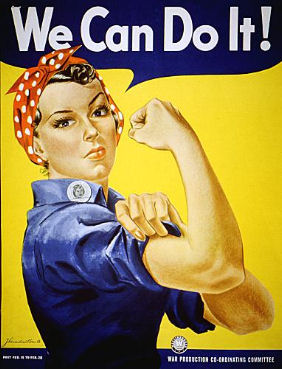 "For women, poetry is not a luxury."
This quote is featured in the epigraph of the chapter, written by Audre Lorde. I found it powerful because I think that women express their emotions as a form of poetry. The chapter discusses the impact of women in the workplace and home. As homemakers, some women experienced "redomestication" during the war. Afterwards, imagery of Rosie the Riveter showed up for awhile until society tried to turn her back into a domesticated housewife.
I felt it was important to embrace the spoken word and I see that resonance today. At times, I feel like there is a hazy line when it comes to feminism. I used to think that feminism was a special group of people fighting for women's rights but it seems that it's just to find equality between the sexes.
It seems as though some look down at the movement because of the differences in opinion when it comes to reproductive rights and demanding protection from violence.
Shirin Neshat discusses universal truths and objects surrounding Iranians around the world. I thought the information was interesting to provide a viewpoint for Americans. She said she did not want to make cliche work but I'm still wondering if she has. By using imagery of women in veils in a natural environment like a desert, her videos seem a bit expected. I think her diversity is interesting and it's great that her work has reached the attention of the Whitney but again with these artists, I expect more.
With the Art of Protest, feminists were focused on the spoken word and these silent films tried expression without speech. It's an interesting concept but I think it portrays Muslim women as being oppressed in their native societies. If you ask women there or here, you'll get a variety of opinions. Yes, women must cover themselves as part of the religion but also Islam provides many rights to them as well. Islam has provided many documents for fairness especially when it comes to prenuptial agreements, marriage contracts and wills. Certain cultures restrict women more but people have to realize not everything they hear is part of the religion. I felt like Neshat has a good approach, but not necessarily a different one.
Tuesday, October 23, 2007
Much Confusion.....
After reading this week's assignment in "The Art of Protest", I fail to see how the actions of the Black Panthers are considered art. I don't know entirely that much about art, but when does violence and fear become a part of it? From what I know about their time period, there was so much injustice being done to their people and a change was definitely necessary, but I came away from the text feeling as if they just fueled the fire for more stereotypes and problems to arise for their race. I don't know how violence and fear can ever produce a positive outcome, and I feel that these are the tactics that they utilized the most. Maybe they felt that desparate times called for desparate measures, but I believe in most, if not all cases, violence is not the answer. And their "Ten Point Point Program" seemed so hateful and threatening. Wasn't hate and discrimination the things they were fighting against? Reading through it really made me feel awful, ugly, and a little angry inside. I can't imagine that anyone would consider complying to something that made them feel this way. I felt like I was being accused and screamed at. Hmmm, I would like to hear what other people think about the text tomorrow. I am curious if I am the only one that feels this way....
As for the artist, Arnaldo Morales, of "In the Making", no other person that I have read about in my art courses has scared me more. His art pieces are so creepy, infliscting pain on those who view them. I got the feeling from the article that the artist connects with people through hurting them. That is not cool with me. I kept thinking throughout this article, "I gotta remember this guy's name. I NEVER want to be browsing his exhibits." The other thing that really disturbed me was the carelessness of this man's mother. What parent would allow their child to cut metal with a saw at age 4 or 5? It is madness, and I bet if someone would have known, his mom would have been reported to the CPS. As a future teacher, has and is presently working with young children, I am very angered when I hear of any child being put in danger, ESPECIALLY when it involves their parents. >:O
As for the artist, Arnaldo Morales, of "In the Making", no other person that I have read about in my art courses has scared me more. His art pieces are so creepy, infliscting pain on those who view them. I got the feeling from the article that the artist connects with people through hurting them. That is not cool with me. I kept thinking throughout this article, "I gotta remember this guy's name. I NEVER want to be browsing his exhibits." The other thing that really disturbed me was the carelessness of this man's mother. What parent would allow their child to cut metal with a saw at age 4 or 5? It is madness, and I bet if someone would have known, his mom would have been reported to the CPS. As a future teacher, has and is presently working with young children, I am very angered when I hear of any child being put in danger, ESPECIALLY when it involves their parents. >:O
Monday, October 22, 2007
Cat and mouse
Hi everyone,
How are the costume ideas coming along? Anyone want to share ideas of what they've been working on so far? I'm excited about this project but I hope I can finish my idea in time or else I'll feel silly walking in a parade looking like a goof, which may be the result regardless, haha :)
For the readings this week, I felt like The Art of Protest went nicely in-depth about the "black power" movement. I found the phrase 'black aesthetic' to be rather interesting to coin how the movement geared itself. The techniques used are works of performance art because the Black Panthers incorporated courtroom dramas and plays that followed the law so well that true identities were unknown.
I also felt it was important to bring up rap and hip-hop culture during this time and afterwards. Acts like Public Enemy, Tupac, Salt n' Pepa and Queen Latifah had much to say on the issues affecting them. I wonder if anyone saw that one episode of The Fresh Prince of Bel-Air where Will felt empowered by reading about Malcolm X that he was ready to leave in order to protest. It was important to see that his character understand the gravity of the situation and to use his frustration constructively to make a point rather than create more havoc in the streets.
When I read the section on black men being exempt from military service, I had to think of Muhammad Ali who was formerly Cassius Clay until he converted to Islam. It's interesting how the world is connected. I feel also that the role of feminism and the power of the female flourished due to these expressive acts. Black women today speak their mind and I think this is a result of the movement.
As for In the Making, after reading just a couple paragraphs on Arnaldo Morales, I know that I've connected with his work more than any other artist in this book. I think at some point in our lives that we should wake up and have an epiphany about where we are and where we're going.
The final thoughts on opposites was particularly powerful: "Panic meets pleasure. Danger conspires with excitement. Aggression motivates rehabilitation. Pain is linked to sensuality. These unlikely mergers create awareness of the widespread ambivalence over presumed taboos and accepted behaviors."
True that, homie.
How are the costume ideas coming along? Anyone want to share ideas of what they've been working on so far? I'm excited about this project but I hope I can finish my idea in time or else I'll feel silly walking in a parade looking like a goof, which may be the result regardless, haha :)
For the readings this week, I felt like The Art of Protest went nicely in-depth about the "black power" movement. I found the phrase 'black aesthetic' to be rather interesting to coin how the movement geared itself. The techniques used are works of performance art because the Black Panthers incorporated courtroom dramas and plays that followed the law so well that true identities were unknown.
I also felt it was important to bring up rap and hip-hop culture during this time and afterwards. Acts like Public Enemy, Tupac, Salt n' Pepa and Queen Latifah had much to say on the issues affecting them. I wonder if anyone saw that one episode of The Fresh Prince of Bel-Air where Will felt empowered by reading about Malcolm X that he was ready to leave in order to protest. It was important to see that his character understand the gravity of the situation and to use his frustration constructively to make a point rather than create more havoc in the streets.
When I read the section on black men being exempt from military service, I had to think of Muhammad Ali who was formerly Cassius Clay until he converted to Islam. It's interesting how the world is connected. I feel also that the role of feminism and the power of the female flourished due to these expressive acts. Black women today speak their mind and I think this is a result of the movement.
As for In the Making, after reading just a couple paragraphs on Arnaldo Morales, I know that I've connected with his work more than any other artist in this book. I think at some point in our lives that we should wake up and have an epiphany about where we are and where we're going.
The final thoughts on opposites was particularly powerful: "Panic meets pleasure. Danger conspires with excitement. Aggression motivates rehabilitation. Pain is linked to sensuality. These unlikely mergers create awareness of the widespread ambivalence over presumed taboos and accepted behaviors."
True that, homie.
Friday, October 19, 2007
The Protest Effect
I think the reason I am so interested in The Art of Protest is how far into the history of protest movements the book goes. The Civil Rights Movement has not only influenced my life but it has influenced the world (or maybe just a Western section).
In my last blog I discussed how shocked I was at the myths of the movement. Chapter two now has me mystified at the Blank Panther influence and affect during the movement's era. Growing up I can remember television and movies using the Black Power fist as a joke or a common display of pride. In today's time I don't think it really has any meaning. I think the dramatic gesture went with the dramatic times. Now that there is less (not nothing, just less) to fight for, at least specifically in our country, our generation doesn't appreciate or understand everything that has preceded and provided our luxuries.
While the Civil Rights Movement was necessary, I feel that certain aspects of the Black Panther movement were not. I am not a fan of violence in any way; I believe it is only necessary when your life, or the lives of loved or innocent ones, are in danger. The Panthers, I think, used violent language and action because they did not have the right words and actions. Cursing and guns are verbal and physical ways to make up what you lack, but its like a shell: hard on the outside with nothing actually in it. "The black power movement attempted to give shape to the inchoate 'black rage' that fueled the riots, and turn it into empowerment rather than self-destruction" (44). The movement did provide a way to shape all the hostility and hurt and anger in the black community into something useful and empowering but they did it in a way that furthered segregation and at the same time stereotypes.
I am thankful that such movements existed because it freed a people (and I'm sure was a role to others) from feelings of helplessness and despair, and gave a sense of lasting hope that things could get better. It's ironic however that a big reason for the movement's end came from internal battles. I did not know that Panthers killed fellow Panthers and other black activists. I did not know that during its time of winding down a big issue was hierarchy and infiltration by outside police forces. I think that's the biggest disappointment. Their goal was to better their society and celebrate their roots but they existed in a money-run bubble of paranoia and violence they created by themselves. Can't blame that one on white people.
To tie this all together, I just feel that the Black Panther Movement didn't employ enough of the advantages, artistic and dynamic, they had on their side. Instead they used the skillful and talented artists, poets, orators, playwrights, authors, and people to create violence and havoc, while at the same time making a lasting and irreversible impression in the African American culture.
In my last blog I discussed how shocked I was at the myths of the movement. Chapter two now has me mystified at the Blank Panther influence and affect during the movement's era. Growing up I can remember television and movies using the Black Power fist as a joke or a common display of pride. In today's time I don't think it really has any meaning. I think the dramatic gesture went with the dramatic times. Now that there is less (not nothing, just less) to fight for, at least specifically in our country, our generation doesn't appreciate or understand everything that has preceded and provided our luxuries.
While the Civil Rights Movement was necessary, I feel that certain aspects of the Black Panther movement were not. I am not a fan of violence in any way; I believe it is only necessary when your life, or the lives of loved or innocent ones, are in danger. The Panthers, I think, used violent language and action because they did not have the right words and actions. Cursing and guns are verbal and physical ways to make up what you lack, but its like a shell: hard on the outside with nothing actually in it. "The black power movement attempted to give shape to the inchoate 'black rage' that fueled the riots, and turn it into empowerment rather than self-destruction" (44). The movement did provide a way to shape all the hostility and hurt and anger in the black community into something useful and empowering but they did it in a way that furthered segregation and at the same time stereotypes.
I am thankful that such movements existed because it freed a people (and I'm sure was a role to others) from feelings of helplessness and despair, and gave a sense of lasting hope that things could get better. It's ironic however that a big reason for the movement's end came from internal battles. I did not know that Panthers killed fellow Panthers and other black activists. I did not know that during its time of winding down a big issue was hierarchy and infiltration by outside police forces. I think that's the biggest disappointment. Their goal was to better their society and celebrate their roots but they existed in a money-run bubble of paranoia and violence they created by themselves. Can't blame that one on white people.
To tie this all together, I just feel that the Black Panther Movement didn't employ enough of the advantages, artistic and dynamic, they had on their side. Instead they used the skillful and talented artists, poets, orators, playwrights, authors, and people to create violence and havoc, while at the same time making a lasting and irreversible impression in the African American culture.
Tuesday, October 16, 2007
Free expression for a price
Kelsey and Kayse,
I felt your responses on the "In the Making" and "Art of Protest" readings were interesting because they discussed ideas within the Civil Rights Movement and free expression. I'm actually taking a class this semester to finish up my Electronic Journalism minor called COMM 454: Free Speech and Ethics where we also discuss these ideas. We haven't discussed the Civil Rights Movement in detail yet, but we've been addressing theories and how free speech is contained today.
I always wonder about the Free Speech Zone out by the clock tower. It sparked an exciting side note about Mr. Bibleman who shows up every semester to pass out Biblical literature to tell us that we're all going to hell. He's somewhat of a pleasant man, I hope...haha.
As I discussed earlier in another blog entry, religious pieces are effective but also weird. Sometimes I wonder if artists just make things to be noticed. I find the animal feces rather resourceful, but odd. I guess I need to look more into the artist's techniques and processes before I can get a grasp of what they're trying to say.
For me, I have a conservative background despite being very liberal so I found works like this pushing the envelope of what I've grown up with to what I'm going into. A weird segway, I'm sure.
I felt your responses on the "In the Making" and "Art of Protest" readings were interesting because they discussed ideas within the Civil Rights Movement and free expression. I'm actually taking a class this semester to finish up my Electronic Journalism minor called COMM 454: Free Speech and Ethics where we also discuss these ideas. We haven't discussed the Civil Rights Movement in detail yet, but we've been addressing theories and how free speech is contained today.
I always wonder about the Free Speech Zone out by the clock tower. It sparked an exciting side note about Mr. Bibleman who shows up every semester to pass out Biblical literature to tell us that we're all going to hell. He's somewhat of a pleasant man, I hope...haha.
As I discussed earlier in another blog entry, religious pieces are effective but also weird. Sometimes I wonder if artists just make things to be noticed. I find the animal feces rather resourceful, but odd. I guess I need to look more into the artist's techniques and processes before I can get a grasp of what they're trying to say.
For me, I have a conservative background despite being very liberal so I found works like this pushing the envelope of what I've grown up with to what I'm going into. A weird segway, I'm sure.
Civil Rights and Ofili
"The Art of Protest" began differently than I had expected. I had originally thought that the book would be about protest art, but I guess I was wrong. The first chapter talked all about the Civil Rights movement and about how much of what I knew to be true about it was, in fact, false. Here are some of the things I learned:
1. Many of the efforts were those of black WOMEN, not men, like I had thought
2. Martin Luther King, Jr. was not the movement's leader
3. The movement was not entirely supported by the church, in fact, it was condemned by some
4. Very few white people at all had anything to do with the movement or its success :(
The chapter also discussed the incorporation of music in the movement and its power. I had known about music beng used in times of protest or trouble, so it was no surprise to me to be hearing this information. In fact, I had learned years before of the 'spirituals' in times of slavery and how they had an influence on history even after that time period had come to a close.
As for the artist in this week's article from, "In the Making", I wish I could be so thoughtful and reflective. I found his painting, "Holy Mother of God" to be one of the more offensive works of art that I have encountered thus far. I do not understand artists who manipulate religious symbols to manifest their thoughts. Why can't they use something else, possibly something original, since they are 'so creative.'
I don't know what bothers me more about this painting.
1. The fact that there is elephant dung on it
2. That the elephant dung is a breast
3. That the breast does not symbolize motherhood, but sexuality
4. That the other pieces of dung are supporting the painting, so it can 'stand in its own crap' (i don't use the term he said)
5. The 'crotch shot' and buttocks 'butterflies'
6. The vaginal symbols everywhere in the hair AND dress of the virgin
Ugh, this painting makes me so angry. It is NO WONDER why people were so upset. I TOTALLY understand why. How dare he twist the virgin mother into a sex object?! He could have got his point across in another way. Just like Serrano, I have no respect or anything positive to say about an artist who manipulates religious symbols, I think it's just wrong. The end.
1. Many of the efforts were those of black WOMEN, not men, like I had thought
2. Martin Luther King, Jr. was not the movement's leader
3. The movement was not entirely supported by the church, in fact, it was condemned by some
4. Very few white people at all had anything to do with the movement or its success :(
The chapter also discussed the incorporation of music in the movement and its power. I had known about music beng used in times of protest or trouble, so it was no surprise to me to be hearing this information. In fact, I had learned years before of the 'spirituals' in times of slavery and how they had an influence on history even after that time period had come to a close.
As for the artist in this week's article from, "In the Making", I wish I could be so thoughtful and reflective. I found his painting, "Holy Mother of God" to be one of the more offensive works of art that I have encountered thus far. I do not understand artists who manipulate religious symbols to manifest their thoughts. Why can't they use something else, possibly something original, since they are 'so creative.'
I don't know what bothers me more about this painting.
1. The fact that there is elephant dung on it
2. That the elephant dung is a breast
3. That the breast does not symbolize motherhood, but sexuality
4. That the other pieces of dung are supporting the painting, so it can 'stand in its own crap' (i don't use the term he said)
5. The 'crotch shot' and buttocks 'butterflies'
6. The vaginal symbols everywhere in the hair AND dress of the virgin
Ugh, this painting makes me so angry. It is NO WONDER why people were so upset. I TOTALLY understand why. How dare he twist the virgin mother into a sex object?! He could have got his point across in another way. Just like Serrano, I have no respect or anything positive to say about an artist who manipulates religious symbols, I think it's just wrong. The end.
Friday, October 12, 2007
Civil Rights Secrets
After reading the first chapter of Art of Protest where it tries to dispel the myths of characters and certain ideals that are believed to be major parts of the Civil Rights Movement, I was surprised at my own ignorance.
Basic things like human sexuality never crossed my mind as being anywhere involved in the fight for civil rights. I had a one track mind that Martin Luther King Jr. lead the whole action (another myth I was broken hearted to learn) and community, peacefully, through the country stomping down hatred and demanding equality.
Another thing I failed to noticed was the importance of music in the movement. In journalism class we learned about advertising and using it to spread your message. Catchy tunes and singsongs get stuck in your head and eventually, if only subconsiously, you begin to either support or be prone to that advertisement's messages and goals. If only on the basic levels, songs with a message is advertising a message. And its one of the simplest ways to go about it.
I feel in a way that what I knew about the movement is all wrong now and with that knew knowledge I also feel a bit down. It's hard realizing that for the most part everything you learned is wrong, though that would still be learning. I'm glad to have more information about the women and the gay men that put in the work that you never hear about. I'm also just glad, that no matter what I acutally know about the movement, it still happened.
Basic things like human sexuality never crossed my mind as being anywhere involved in the fight for civil rights. I had a one track mind that Martin Luther King Jr. lead the whole action (another myth I was broken hearted to learn) and community, peacefully, through the country stomping down hatred and demanding equality.
Another thing I failed to noticed was the importance of music in the movement. In journalism class we learned about advertising and using it to spread your message. Catchy tunes and singsongs get stuck in your head and eventually, if only subconsiously, you begin to either support or be prone to that advertisement's messages and goals. If only on the basic levels, songs with a message is advertising a message. And its one of the simplest ways to go about it.
I feel in a way that what I knew about the movement is all wrong now and with that knew knowledge I also feel a bit down. It's hard realizing that for the most part everything you learned is wrong, though that would still be learning. I'm glad to have more information about the women and the gay men that put in the work that you never hear about. I'm also just glad, that no matter what I acutally know about the movement, it still happened.
Tuesday, October 9, 2007
What 5 things am I willing to commit to in order to foster a more sustainable future?
I thought about the aforementioned question for a while and I have found, to my dismay, that I do a lot of things to harm the planet. Unfortunately, I'm not quite sure how many of those things I would give up entirely....Does that make me a bad person? I don't think so, but I am willing to be more aware of my actions in these few areas, at least for now....
1. I am a big energy-waster. Yes, not the best grammar, but nonetheless true. I leave on lights, fans, tvs, computers, you name it, I've probably left it on without using it. It's wrong, I know, I am going to consider my actions in this area henceforth. I am also intrigued by motion detectors that turn lights off and on depending on whether or not there is a person in the room; something to think about.
2. Like Kelsey, I need to work on conserving water, but not only in the shower. I am constantly leaving water running while I brush my teeth, which needs to end. Also, when I am cooking and don't want to do the dishes right away, I have a habit of letting the water run over the dishes until I get to them. I really need to just wash them and get it over with as soon as possible, because my current methods are wasting so much water.
3. I have a bad habit of throwing away my plastic bottles if I don't see a recycling bin in the vicinity. I need to start saving my bottles and bring them home to put in our recycle bins, no matter how inconvenient I feel it is.
4. I feel like I throw away a lot of other stuff that maybe could be recycled, but I'm not quite sure how they are classified. Things like aerosol cans, pill bottles, butter containers, shampoo bottles, etc. Since these things seem to be made out of recyclable materials, I should research the ways in which they are processed.
5. I like to drive a lot; I actually find it therapeutic at times. On many occasions, I have gone driving without a destination, or took the long way home on purpose. But, this is not good for the environment at all. I think that when I have to go out, I should make like one big trip and get as much done as possible so I won't have to go out as much to do errands. And maybe the next time I feel like a long drive, I'll consider a nice walk instead. :)
1. I am a big energy-waster. Yes, not the best grammar, but nonetheless true. I leave on lights, fans, tvs, computers, you name it, I've probably left it on without using it. It's wrong, I know, I am going to consider my actions in this area henceforth. I am also intrigued by motion detectors that turn lights off and on depending on whether or not there is a person in the room; something to think about.
2. Like Kelsey, I need to work on conserving water, but not only in the shower. I am constantly leaving water running while I brush my teeth, which needs to end. Also, when I am cooking and don't want to do the dishes right away, I have a habit of letting the water run over the dishes until I get to them. I really need to just wash them and get it over with as soon as possible, because my current methods are wasting so much water.
3. I have a bad habit of throwing away my plastic bottles if I don't see a recycling bin in the vicinity. I need to start saving my bottles and bring them home to put in our recycle bins, no matter how inconvenient I feel it is.
4. I feel like I throw away a lot of other stuff that maybe could be recycled, but I'm not quite sure how they are classified. Things like aerosol cans, pill bottles, butter containers, shampoo bottles, etc. Since these things seem to be made out of recyclable materials, I should research the ways in which they are processed.
5. I like to drive a lot; I actually find it therapeutic at times. On many occasions, I have gone driving without a destination, or took the long way home on purpose. But, this is not good for the environment at all. I think that when I have to go out, I should make like one big trip and get as much done as possible so I won't have to go out as much to do errands. And maybe the next time I feel like a long drive, I'll consider a nice walk instead. :)
Friday, October 5, 2007
KAKE: Part Deux
Hi everyone,
I'd like to know when we'll be meeting on Monday, (which is the 8th) to get our project underway. If we could schedule a meeting time and place on-campus, that would be great. Let me know at least the day before so I can plan ahead of time. I'm available anytime and all day on Monday to get this done because I won't be available during the week otherwise. The sooner we get the idea out there, the better so that we can document the response.
At this point, any ideas of materials? We also have to consider viewer interaction with the work.
Thanks! :)
Asma
I'd like to know when we'll be meeting on Monday, (which is the 8th) to get our project underway. If we could schedule a meeting time and place on-campus, that would be great. Let me know at least the day before so I can plan ahead of time. I'm available anytime and all day on Monday to get this done because I won't be available during the week otherwise. The sooner we get the idea out there, the better so that we can document the response.
At this point, any ideas of materials? We also have to consider viewer interaction with the work.
Thanks! :)
Asma
Captain Planet, he's a hero, gonna take pollution down to zero
WHAT 5 THINGS AM I WILLING TO COMMIT TO IN ORDER TO FOSTER A SUSTAINABLE FUTURE?
1- The biggest and most difficult habit I am trying to create is faster showers. I don't know the exact number of gallons of water used in one 15 minute shower, but I do know that the 15 mintues of used water could serve 7 Africans in drought-stricken areas of Africa. The showers have been cold and sometimes I have not felt the cleanest (though I probably save my skin moisture and irratatin) but I feel it has been worth it to change my ways when so many people will never have the luxury of just a 15 minute shower
2- I also resuse the plastic super market bags for trashcans or quick totes. I also risk looking a tad on the crazy side when I go to Walmart with pounds of white plastic bags that I drop off in their recycling cans.
3- My family has scarificed our grass in order to conserve water. Instead of using the hose to water the grass, we wait for it to rain. I have found this pretty useful for saving myself a trip to the car wash. Rain has gotten rid of many bird-poop spots instead of the harsh car soaps.
4-Now instead when I get a drink I don't use a straw. Though a straw is extremely small in a pile of trash, it's the easiest thing to give up that helps make an indent in the damage down to our Earth. The same applies for napkins. Cloth or only one paper towel is better than a handful of paper that will be unusable and hurtful to the planet.
5- The final thing on this list--but certainly not the last thing--I will do for sustainability is recycle. Besides refusing a straw or more than one napkin, just remembering to put your glasses and newspapers and plastic bottles in a recycling bin. It costs you no money, is easy, and does the whole world good.
But there is still more I can do. And I'm always, all ears
1- The biggest and most difficult habit I am trying to create is faster showers. I don't know the exact number of gallons of water used in one 15 minute shower, but I do know that the 15 mintues of used water could serve 7 Africans in drought-stricken areas of Africa. The showers have been cold and sometimes I have not felt the cleanest (though I probably save my skin moisture and irratatin) but I feel it has been worth it to change my ways when so many people will never have the luxury of just a 15 minute shower
2- I also resuse the plastic super market bags for trashcans or quick totes. I also risk looking a tad on the crazy side when I go to Walmart with pounds of white plastic bags that I drop off in their recycling cans.
3- My family has scarificed our grass in order to conserve water. Instead of using the hose to water the grass, we wait for it to rain. I have found this pretty useful for saving myself a trip to the car wash. Rain has gotten rid of many bird-poop spots instead of the harsh car soaps.
4-Now instead when I get a drink I don't use a straw. Though a straw is extremely small in a pile of trash, it's the easiest thing to give up that helps make an indent in the damage down to our Earth. The same applies for napkins. Cloth or only one paper towel is better than a handful of paper that will be unusable and hurtful to the planet.
5- The final thing on this list--but certainly not the last thing--I will do for sustainability is recycle. Besides refusing a straw or more than one napkin, just remembering to put your glasses and newspapers and plastic bottles in a recycling bin. It costs you no money, is easy, and does the whole world good.
But there is still more I can do. And I'm always, all ears
Wednesday, October 3, 2007
Go GREEN!
WHAT 5 THINGS AM I WILLING TO COMMIT TO IN ORDER TO FOSTER A SUSTAINABLE FUTURE?
I think I'll just continue on some actions I've been doing on my own. Eventually, I'd like to join a green group and actually do something on campus--separate from The Sustainability Project. I think that project will allow more ideas to flourish for the future.
- Currently, I've been reusing plastic grocery bags. At our house, we use these as trash bags instead of just tossing them out. I also save napkins from lunch and keep them in the house. Another thing I've recently started, is to not accept a receipt from the ATM or gas station or a few shopping bags from certain stores (if they remember to ask me too).
- We also save shopping gift bags and gift boxes to reuse later. We like to combine them into other gifts or use them for carrying stuff around. I've also saved rope from fancy shopping bags to use in projects.
- Since my mom has been out of town for more than a month, I've been washing and reusing plastic cups, which are quicker to wash and ultimately save more water than washing larger glasses.
- In the sculpture studio, we've been collecting random items from the area and on-campus. I used one item in one of my works outside to make furniture. Just think about it--on person's trash is truly another person's treasure.
- I'd like to start making compost for my backyard. Sometimes we place food outside like bread and vegetables on our deck for animals to eat. It might be interesting to combine fruit scraps as well into a bin for compost. Watching it breakdown would be cool because I've seen it on television with gardening shows.
- I'd also like to reduce the amount of toxic chemicals, which I have to go back and see how much I use for projects in general. I don't think it's really that much, but it probably has an impact somewhere.
Tuesday, October 2, 2007
You dig? A closer look at natural resources
 Based on previous responses to the reading, I've noticed a disgust with primordial waste. Now, it's not exactly a material that I would ever enjoy working with, but it does remind me of a piece I learned about like a year ago titled, "Piss Christ."
"Piss Christ" is an image by Andres Serrano, a photographer who took a plastic crucifix with Jesus on it and submerged it into a jar filled with his urine. The photograph was shown in 1989 and I'm sure people still feel strongly against this piece. Yes, it is gross and yes it's weird, but you have to admit that it's unique and causes you to think. What is art? What qualities allow a piece to be called art? Does the piece make you consider a different viewpoint?
I think art crosses boundaries of society because it can communicate radical ideas. This might be blasphemy to some, or it could just be a great photograph because of the highlights. Just thought I would throw something weird out there to the group.
To continue with Skip Shuckman, he is an artist that is similar to Andy Goldsworthy by working with natural materials and landscapes. Goldsworthy makes a commitment to go outside each day to make artworks. His process is stunning and I recommend his Rivers & Tides documentary to anyone. He uses stones, twigs, dandelions and ice as natural materials that are combined to temporarily take forms and ultimately return back to the earth. I like Shuckman's approach to using the earth to help the earth.
I feel like there is a chronological process to the definitions given:
- Emotional Velcro - our own biases that we walk in with
- Carrion Artists - we take and don't give back
- Protocolic - follow ideas but not giving enough constructive criticism
- Bulldozer Consistency - feeling stuck with ideas
- Cleverage - distractions in the art making process
- At-onement - encountering a sudden epiphany about art
- Materiality - realizing the great natural resources around us
- Wilding - a continuation of natural ideas
- Primordial Waste - pushing the buttons of art making with reusing waste, it's often controversial but does have a strong impact
- Unlaxing - when art making becomes part of your daily lifestyle
Cradle to Cradle advises us to use local resources and to take advantage of wind power. Basically, we are better humans if we live more simply and thus care for the environment. Sometimes I do wonder, what am I going to do with all this stuff when I die? It's a depressing thought but sometimes it makes you think about the value of a dollar and the value of our planet.
An interesting bridge between the two texts was the lecture that environmentalist Jim Merkel gave last week on sustainability. He discussed self-sufficiency and says that he has been living on only $5,000 a year for about 18 years. He has a wife and kids and they've encouraged others to grow their own food. He even said that GMU should have dining halls that rely on fruits and vegetables that grow on campus. And even with that, we could use our leftovers to make compost.
Now, that's resourceful.
An interesting bridge between the two texts was the lecture that environmentalist Jim Merkel gave last week on sustainability. He discussed self-sufficiency and says that he has been living on only $5,000 a year for about 18 years. He has a wife and kids and they've encouraged others to grow their own food. He even said that GMU should have dining halls that rely on fruits and vegetables that grow on campus. And even with that, we could use our leftovers to make compost.
Now, that's resourceful.
Monday, October 1, 2007
I'm with you Kayse on the "primordial waste." What exactly is "The process of taking command of our own feces and urine"? I don't care to know. Besides Shukmanns use/view of primordial waste I found his incorporation of organic material and landscape quite enlightening. I totally agree with Schukmann's description of the materialistic world we live in that is manifested by television and money. I have strong views on the media and the evil role it can play on society. Schuckman also mentions how surprised people are with the things he creates with materials that are right under are noses and that we take for granted, it shows how how of touch a lot of people are with nature and how technology makes people forget about the importance of preserving the environment.Another aspect of shuckmanns art that i thought was interesting was the fact that he would make something, let nature have its way with the structure, then reconfigure the artwork, so it was a continously evolving piece.
I Don't Get It.....
Um, so this is the first time that I haven't liked an "In the Making" article. I really didn't get this one at all. I understand the idea behind making art that doesn't harm the environment, but rather works with nature, but this man's work is beyond me. I don't see playing in the dirt as art. When I was reading this article, I couldn't help thinking about the kids I teach. They go outside everyday at recess and make some sort of construction out of nature. Little holes in the ground, piles of grass, planted 'seeds', trenches, etc. They will tell me about them and sometimes show them to me. When I was a child, I did similar things. I used nature as a toy. That's what I think this guy is doing, playing with nature, not really accomplishing anything. I understand that his pieces are used for specific purposes and are far more complicated than a hole in the ground, but I just can't wrap my head around calling what he does art. I also don't like the fact that he has 'clients.' Do these people pay him to play in the dirt and make them something that is so temporary that the next rain might destroy it entirely? No, I don't like this arrangement at all. I'm glad you enjoyed it though, Kelsey :) Maybe we can talk about why you do in class and I'll be able to understand this artist better. Oh, and I notcied that you didn't include one of his terms that actually stuck out to me the most...
Primordial waste: The process of taking command of our own feces, urine, and other by-products, bypassing public health management and centralized treatment systems, and returning them to usefulness in our resource base.
Eww, did you not also find this distgusting? Does he mean to recycle our waste or turn it into art or something? I don't know about you, but I totally do not support 'art', and I use the term very loosely, that includes bodily waste. How disturbing.
ps- i'm up for either idea, just lemme know....
Primordial waste: The process of taking command of our own feces, urine, and other by-products, bypassing public health management and centralized treatment systems, and returning them to usefulness in our resource base.
Eww, did you not also find this distgusting? Does he mean to recycle our waste or turn it into art or something? I don't know about you, but I totally do not support 'art', and I use the term very loosely, that includes bodily waste. How disturbing.
ps- i'm up for either idea, just lemme know....
Friday, September 28, 2007
I want a piece of that (does anyone see that I keep making cake references in my titles??)
Finally, In the Making gives me an article and an artist I like and can understand!
What I have believed most about art is that it is firstly, and mostly, personal. Art is something that should be appreciated but is not (I think) created for that sole purpose. However, I have also found that looking at art, especially art created with more than a desire to make a pretty picture, but with a passionate message, has always felt a bit intrusive. I am looking at images from someone's soul. The art isn't something that was seen by many (or more than one person), like a photograph of someone on the street. There must have been other people on that same street seeing that same person. But a painting or a drawing or a sculpture that came from the artist arranging objects or posing a person or just pictured in their head was something that no one else saw or thought of and now I'm looking at it without even asking.
Now there is an artists whose main objective is take your tools and suggestions to heart and make something beautiful, useful, natural, and eco-friendly (in the good way, not in the awful ways that Cradle to Cradle makes eco-friendlyness sound)
Skip Schuckmann is the first, and only artist I know, to have not only his own vocabulary. but a personally invested goal to make a committed relationship to the people who want his artwork. "The relationships are often sustained for decades. The nature of work expands when it is based upon an 'until death do us part' commitment" (p 38). But its not just his dedication to a sustaining relationships that keep the communication and interaction going, but also that the nature of the work is meant to constantly evolve with the nature that the art comes from. Every twig used as a support beam in the underground house is a reusable support beam in the above ground ruins collage (or something). "Even an elaborate configuration that he has just constructed, and that his clients have just paid him for, always remains catalogued as a raw material for succedding manifestations" (p 38).
My favorite part of the article though was the ending glossary of Schuckmann lingo. My favorites were
Unlaxing- the design of a lifestyle in which work is so satisfying that vacations and retirement become undesirable.
I like this word because it is something we should all want for our lives
Emotional Velcro- The greed and laziness that make us stick to our ideas about ourselves
This is a favorite because changing, even for the better, is so hard
Protocolic- The discomfort that ensues from excessive politeness
Who doesn't hate super dupre pleasantries all the time?
At-onement- The physical and mystical interconnectedness of all things
I love this word because it makes you see the similarities we all share and that can help us overcome the differences we do have and eventually, hopefully, possibly, lead to understanding
ps) I think we should do the black-eyed thing, just because it's more artsy BUT I like the message behind the napkin idea, so someone else vote so we can get started =)
pss) I don't think I will ever enjoy Cradle to Cradle; does that make me Republican?
What I have believed most about art is that it is firstly, and mostly, personal. Art is something that should be appreciated but is not (I think) created for that sole purpose. However, I have also found that looking at art, especially art created with more than a desire to make a pretty picture, but with a passionate message, has always felt a bit intrusive. I am looking at images from someone's soul. The art isn't something that was seen by many (or more than one person), like a photograph of someone on the street. There must have been other people on that same street seeing that same person. But a painting or a drawing or a sculpture that came from the artist arranging objects or posing a person or just pictured in their head was something that no one else saw or thought of and now I'm looking at it without even asking.
Now there is an artists whose main objective is take your tools and suggestions to heart and make something beautiful, useful, natural, and eco-friendly (in the good way, not in the awful ways that Cradle to Cradle makes eco-friendlyness sound)
Skip Schuckmann is the first, and only artist I know, to have not only his own vocabulary. but a personally invested goal to make a committed relationship to the people who want his artwork. "The relationships are often sustained for decades. The nature of work expands when it is based upon an 'until death do us part' commitment" (p 38). But its not just his dedication to a sustaining relationships that keep the communication and interaction going, but also that the nature of the work is meant to constantly evolve with the nature that the art comes from. Every twig used as a support beam in the underground house is a reusable support beam in the above ground ruins collage (or something). "Even an elaborate configuration that he has just constructed, and that his clients have just paid him for, always remains catalogued as a raw material for succedding manifestations" (p 38).
My favorite part of the article though was the ending glossary of Schuckmann lingo. My favorites were
Unlaxing- the design of a lifestyle in which work is so satisfying that vacations and retirement become undesirable.
I like this word because it is something we should all want for our lives
Emotional Velcro- The greed and laziness that make us stick to our ideas about ourselves
This is a favorite because changing, even for the better, is so hard
Protocolic- The discomfort that ensues from excessive politeness
Who doesn't hate super dupre pleasantries all the time?
At-onement- The physical and mystical interconnectedness of all things
I love this word because it makes you see the similarities we all share and that can help us overcome the differences we do have and eventually, hopefully, possibly, lead to understanding
ps) I think we should do the black-eyed thing, just because it's more artsy BUT I like the message behind the napkin idea, so someone else vote so we can get started =)
pss) I don't think I will ever enjoy Cradle to Cradle; does that make me Republican?
Monday, September 24, 2007
"Work makes work" --Richard Serra
Cradle to Cradle is intelligently written. As I hold this small text in my hands, I feel as though it is talking down to me. I do understand the severity of the situation but this a major guilt trip. By comparing the two types of bookmaking, one is highly advanced while the other dematerializes quickly. Both are making an effort to help the environment, just in different ways. With the two comparison of two types of lawns as either natural or civilized, I can blend the two ideas together.
We should be a natural civilization. Now, who is going to listen? Are huge companies reading this same info or even caring?
In the Making discusses Betsy Damon as an activist who questions what we are drinking in our water. This is an interesting concept because when something goes wrong, we say "There must be something in the water." Without water, we will not survive. It's a vital and natural resource for our own human sustainability. Damon believes that water as the source of all life can be a foundation to bring us all together.
When it comes to the environment and the art making process, I feel strange. Painters use expensive and toxic materials to paint an image. Sculptors require the most material and produce a lot of waste in order to create a piece that will make a statement while pushing down the grass. I try to recycle material but is it enough? We dwell in toxicity. We use these mediums to make a point. But are we really understanding it?
Damon allows water to become the main priority as it trickles and bubbles in the outdoor environment as flowing forms. This was a great project but there's just something about it that's not cutting it for me. When the artists discusses how the piece is about itself and not the success of the artist, I felt a bit blah. Artists and art majors want recognition.
Sure, fame and fortune are great but I feel as though that some are romanticized with the process without taking a second glance. At the end of the day, the artist's name is attached to the work. Success comes in different forms. At times I feel like artists are conditioned to have these ideas about making art about the art. We care so much about the environment but are we part of the cure instead of the disease?
With Cradle to Cradle, it reminds me of Freakonomics, which sounds like a business model for our lives. I just wish that In the Making gets down to the process and craft of the works rather than focusing on the intent of the artist. I guess I just need more details.
We should be a natural civilization. Now, who is going to listen? Are huge companies reading this same info or even caring?
In the Making discusses Betsy Damon as an activist who questions what we are drinking in our water. This is an interesting concept because when something goes wrong, we say "There must be something in the water." Without water, we will not survive. It's a vital and natural resource for our own human sustainability. Damon believes that water as the source of all life can be a foundation to bring us all together.
When it comes to the environment and the art making process, I feel strange. Painters use expensive and toxic materials to paint an image. Sculptors require the most material and produce a lot of waste in order to create a piece that will make a statement while pushing down the grass. I try to recycle material but is it enough? We dwell in toxicity. We use these mediums to make a point. But are we really understanding it?
Damon allows water to become the main priority as it trickles and bubbles in the outdoor environment as flowing forms. This was a great project but there's just something about it that's not cutting it for me. When the artists discusses how the piece is about itself and not the success of the artist, I felt a bit blah. Artists and art majors want recognition.
Sure, fame and fortune are great but I feel as though that some are romanticized with the process without taking a second glance. At the end of the day, the artist's name is attached to the work. Success comes in different forms. At times I feel like artists are conditioned to have these ideas about making art about the art. We care so much about the environment but are we part of the cure instead of the disease?
With Cradle to Cradle, it reminds me of Freakonomics, which sounds like a business model for our lives. I just wish that In the Making gets down to the process and craft of the works rather than focusing on the intent of the artist. I guess I just need more details.
Actions Speak Louder Than Words
Is it just me, or is anyone else really frustrated with the "Cradle to Cradle" text? I'm truly upset with it. It seems more like a rant than a solution to anything. When I began to read chapter three and it started talking about the book not being made out of paper AGAIN, I was like, "This book is going nowhere." But, maybe it's just me, maybe I'm not getting it.
However, I have found that I enjoy the other text "Art in the Making", immensely. Especially this week's section about the artist, Betsy Damon. Here is someone who is concerned about the environment and it actually doing something about it. The article talks about how she was a conventional artist, one that was concerned with "income, number of solo exhibitions, and mentions in the art press" (p.356), and how she transformed herself into an activist artist.
Her main concern became the world's water supply as "the living bodies we have inherited, and the recognition that our DNA is immutably dependant on water." (p.356)
She created a nonprofit organization in 1990 called Keepers of the Waters, which brought many people together from many different fields to create water-treatment systems. Damon and her organization put on performances in the city of her focus, Chengdu, China, to show the citizens just how dirty their water was. Her efforts led to the construction of a 'living water park' which she designed, to educate people about their precious resource.
I love how this woman made herself a part of the solution instead of just talking about a problem. She went above and beyond by going to the people and making things happen. I hate it when people write books, hold campaigns, make films, etc. that accomplish nothing. I feel that to get anything accomplished, you yourself have to get out there and make it happen. Like the old adage in my title, "Actions speak louder than words."
However, I have found that I enjoy the other text "Art in the Making", immensely. Especially this week's section about the artist, Betsy Damon. Here is someone who is concerned about the environment and it actually doing something about it. The article talks about how she was a conventional artist, one that was concerned with "income, number of solo exhibitions, and mentions in the art press" (p.356), and how she transformed herself into an activist artist.
Her main concern became the world's water supply as "the living bodies we have inherited, and the recognition that our DNA is immutably dependant on water." (p.356)
She created a nonprofit organization in 1990 called Keepers of the Waters, which brought many people together from many different fields to create water-treatment systems. Damon and her organization put on performances in the city of her focus, Chengdu, China, to show the citizens just how dirty their water was. Her efforts led to the construction of a 'living water park' which she designed, to educate people about their precious resource.
I love how this woman made herself a part of the solution instead of just talking about a problem. She went above and beyond by going to the people and making things happen. I hate it when people write books, hold campaigns, make films, etc. that accomplish nothing. I feel that to get anything accomplished, you yourself have to get out there and make it happen. Like the old adage in my title, "Actions speak louder than words."
Sunday, September 23, 2007
Is cake even good for the environment?
Again, and unfortunately, Cradle to Cradle brings up the point that eco-efficiency or any attempt it seems, does nothing but prolong our inevitable and eminent death of the world. From our houses to our books we are doing damage, if not immediately then for the future. I know that the goal of this book is to inform the masses (or whoever happens to read the book) of the destruction we do everyday in our simple activities. Even reading!!
I hear their solution for the books. But the work that goes into it, and the money that is spent, and the jobs that are lost, just (well not just) for a book to be biodegradable, or simply reusable, are not for me good enough reasons. I want to save the planet. I really do. But I will not take a job away from a man or woman in need of that factory position. I will not cut a tax that might go to education or health care, for solar power implementation. I will not.
To become eco-friendly-efficient-effective-harmless, there is still so much left to think about and to research. I will listen, truly listen and want to apply the ideas of McDonough and Braungart when they tell me what will happen to the people who lose their jobs, to the people who have to totally redo their buildings in the name of eco-ness, to the people who can’t afford to change their habits.
In the book we are compared to ants, who “collectively their biomass exceeds ours” (79). Good for the ants that can live off leaves. The world is compared to a cherry tree who lives off the nutrients of the ground and are able to feed people with their byproduct. If we could live of photosynthesis and rain water, I’m sure obesity would be down and raccoons would have less garbage to plunder through. Regrettably we are not these things. I’m still looking for Cradle to Cradle to give me something plausible, something I can get behind without worrying about the harm that it can do to the people. We can save the Earth, but if in that process we hurt the people living on it, what good do we actually accomplish?
I hear their solution for the books. But the work that goes into it, and the money that is spent, and the jobs that are lost, just (well not just) for a book to be biodegradable, or simply reusable, are not for me good enough reasons. I want to save the planet. I really do. But I will not take a job away from a man or woman in need of that factory position. I will not cut a tax that might go to education or health care, for solar power implementation. I will not.
To become eco-friendly-efficient-effective-harmless, there is still so much left to think about and to research. I will listen, truly listen and want to apply the ideas of McDonough and Braungart when they tell me what will happen to the people who lose their jobs, to the people who have to totally redo their buildings in the name of eco-ness, to the people who can’t afford to change their habits.
In the book we are compared to ants, who “collectively their biomass exceeds ours” (79). Good for the ants that can live off leaves. The world is compared to a cherry tree who lives off the nutrients of the ground and are able to feed people with their byproduct. If we could live of photosynthesis and rain water, I’m sure obesity would be down and raccoons would have less garbage to plunder through. Regrettably we are not these things. I’m still looking for Cradle to Cradle to give me something plausible, something I can get behind without worrying about the harm that it can do to the people. We can save the Earth, but if in that process we hurt the people living on it, what good do we actually accomplish?
Tuesday, September 18, 2007
A Bug's Life
The first two chapters of Cradle to Cradle were pretty cool. For a book that's not made out of tree, I was actually impressed. I wonder if this affects the overall cost because for a smaller text, the price is a little more than average. I was tempted to spill something on the pages to test how waterproof the book was.
I know that all this info can be overwhelming but I found out towards the end of Chapter 2 is that our perception tends to be depressing. I think this drags us down and ultimately to do nothing. However, any small action to reduce our carbon footprint is definitely worth it. We have to ask ourselves: Am I truly doing the best I can to resolve the situation?
The common conclusion is that the problem will not be solved. It's just that we're buying time. I find this to be an interesting concept because we know we're not doing enough and yet we continue this cycle of wastefulness. I try to do different things to help the environment but should I feel like a hypocrite if I want to buy a Hummer? Is it my fault that I feel adventurous and want an awesome vehicle to go off-roading? It's like you can only go so far and then you're stopped because there are some things you can't compromise.
I enjoyed reading about Yanagi's interpretation of a natural line by following a single ant with a red crayon. He is able to distinguish how religion or ethnic groups cannot identify the individual but rather that the self can control this through behavior and the pursuit of freedom. It makes you realize how similar humans and ants can be. Although we vary in size, we both spends hours of our lives waiting and walking in a line.
I know that all this info can be overwhelming but I found out towards the end of Chapter 2 is that our perception tends to be depressing. I think this drags us down and ultimately to do nothing. However, any small action to reduce our carbon footprint is definitely worth it. We have to ask ourselves: Am I truly doing the best I can to resolve the situation?
The common conclusion is that the problem will not be solved. It's just that we're buying time. I find this to be an interesting concept because we know we're not doing enough and yet we continue this cycle of wastefulness. I try to do different things to help the environment but should I feel like a hypocrite if I want to buy a Hummer? Is it my fault that I feel adventurous and want an awesome vehicle to go off-roading? It's like you can only go so far and then you're stopped because there are some things you can't compromise.
I enjoyed reading about Yanagi's interpretation of a natural line by following a single ant with a red crayon. He is able to distinguish how religion or ethnic groups cannot identify the individual but rather that the self can control this through behavior and the pursuit of freedom. It makes you realize how similar humans and ants can be. Although we vary in size, we both spends hours of our lives waiting and walking in a line.
Monday, September 17, 2007
Finally, I can relate to something.....
Since the beginning of this class, I have felt very lost and confused. I don't know that much about art or social action, so I have had trouble trying to make connections between the two. From the first article we read, I made little constructive opinions. I had shallow reactions towards them and was not able to get under the surface to the meaning of the art. I also felt an overwhelming negativity surrounding the subjects and I could not appreciate the things I was learning. And even in the following week, when we discussed the film "An Inconvenient Truth" and the article about the "Mud Man", I was still like "So what?" I had already known about global warming and the impending doom our planet will face and I was very unimpressed by the artist known as "Mud Man." It is only this week's reading in "In the Making" that I found something to be remotely interesting and carried a positive message, for once.
This week's artist featured in "In the Making" was Yukinori Yanagi. When I first started reading the short biography on the artist, I was bracing myself for disappointment. But instead, I was meet with a pleasant suprise. This man's artwork revolves around ants and various metaphors to life and people that he attaches to them. Now, this may not seem so impressive, but the things the artist accomplishes with common insects and the deep meaning that results is nothing less than fascinating. On the opposite page of the bio, we see the artist crouching in a large square with various red-orange markings throughout. This may not look like a masterpiece to the human eye, but that is because it was not created by a human, but by a single, miniscule ant.
I am completely blown away by what this artist has done. He has taken something so ordinary, and made it unbelievably extraordinary. He has found ways to bring concepts to life in social, political, religious, and natural realms. How powerful is that? I especially liked his piece entitled "Asia Pacific Ant Farm." In the piece, Yanagi links together many different ant farms with colored sand in them, making them resemble nation's flags. As the ants move about and in between the farms, they create trails by dragging the colored sands everywhere they go, thus uniting all the farms/ nations. Isn't the concept represented by this piece truly astounding? That all people are united, as demonstrated by ants? All I have left to say is "Wow, that is so deep."
This week's artist featured in "In the Making" was Yukinori Yanagi. When I first started reading the short biography on the artist, I was bracing myself for disappointment. But instead, I was meet with a pleasant suprise. This man's artwork revolves around ants and various metaphors to life and people that he attaches to them. Now, this may not seem so impressive, but the things the artist accomplishes with common insects and the deep meaning that results is nothing less than fascinating. On the opposite page of the bio, we see the artist crouching in a large square with various red-orange markings throughout. This may not look like a masterpiece to the human eye, but that is because it was not created by a human, but by a single, miniscule ant.
I am completely blown away by what this artist has done. He has taken something so ordinary, and made it unbelievably extraordinary. He has found ways to bring concepts to life in social, political, religious, and natural realms. How powerful is that? I especially liked his piece entitled "Asia Pacific Ant Farm." In the piece, Yanagi links together many different ant farms with colored sand in them, making them resemble nation's flags. As the ants move about and in between the farms, they create trails by dragging the colored sands everywhere they go, thus uniting all the farms/ nations. Isn't the concept represented by this piece truly astounding? That all people are united, as demonstrated by ants? All I have left to say is "Wow, that is so deep."
Friday, September 14, 2007
second helping of KAKE
The world is going to end and it must be my fault. That's how I felt after reading Chapters 1 and 2 from Cradle to Cradle. While it brought new and interesting information to my attention, I felt that it offered no viable solution except to wait to find one in the mist of the pollution we will obviously continue to make.
This morning as my suite-mates and I sprayed our aerosal spray cans of hairspray and threw away non-biodegradable plastic make-up containers I couldn't help but recall the chapters and what was going to happen--what was happening--to the planet as our hair became stiffer and our trash cans filled. The o-zone holes were getting bigger and land-fills were piling up with plastics that would remain there until they were burned.
Reduse, Reuse, Recycle(Cradle to Cradle, 53). I GOT IT! I GOT IT! But apparently, no matter how much I recycle, reuse, or reduse, it will never be enough or even begin to undue the damage started with the Industrial Revolution. The chapter explains the harm in almost every attempt to become more eco-friendly. We cut down the amount of oil used to for heating and cooling the average home by more than 95% and are left with poor polluted air in our houses (63).
I want to be part of the Strategy of Change not Strategy of Tragedy (44), as coined in Chapter 1. But if what I'm doing now isn't enough, I need to know what will be. I felt enlightened after reading and knowing more about the state of our planet, but five seconds later I felt deflated, realizing how little I difference I can make, if even eco-efficiency is still so damaging. "Eco-efficiency only works to make the old, destructive system a bit less so" (62) so where, oh where, is the solution?
Hopefully in the following chapters.
This morning as my suite-mates and I sprayed our aerosal spray cans of hairspray and threw away non-biodegradable plastic make-up containers I couldn't help but recall the chapters and what was going to happen--what was happening--to the planet as our hair became stiffer and our trash cans filled. The o-zone holes were getting bigger and land-fills were piling up with plastics that would remain there until they were burned.
Reduse, Reuse, Recycle(Cradle to Cradle, 53). I GOT IT! I GOT IT! But apparently, no matter how much I recycle, reuse, or reduse, it will never be enough or even begin to undue the damage started with the Industrial Revolution. The chapter explains the harm in almost every attempt to become more eco-friendly. We cut down the amount of oil used to for heating and cooling the average home by more than 95% and are left with poor polluted air in our houses (63).
I want to be part of the Strategy of Change not Strategy of Tragedy (44), as coined in Chapter 1. But if what I'm doing now isn't enough, I need to know what will be. I felt enlightened after reading and knowing more about the state of our planet, but five seconds later I felt deflated, realizing how little I difference I can make, if even eco-efficiency is still so damaging. "Eco-efficiency only works to make the old, destructive system a bit less so" (62) so where, oh where, is the solution?
Hopefully in the following chapters.
Where's the snow?
 Group Project #1: Glacier National Park
Issue: At the current rate of retreat, all of the glaciers in Glacier National Park will be gone by 2070.
Audience: A political action committee (PAC) on environmental issues in Richmond, Virginia.
Glacier National Park
GNP Centennial Initiative
Wednesday, September 12, 2007
glacier KAKE
Hey dude and dudettes
I've been thinking about the project, and while I love love LOVE the idea of a glacier cake and everything, I'm afraid that's its not serious enough for our assigned audience or our teachers in general. I'd like to keep the cake idea for sure but I think there needs to be more to it. I'll look stuff up, but do you guys have more ideas or suggestions or anthing you disagree with?? I'm also writing the manefesto tonight and I'll hopefully have it emailed to you tonight or tomorrow, but feel free to email me changes, suggestions, additions....subtractions(?)!
-Kelsey
I've been thinking about the project, and while I love love LOVE the idea of a glacier cake and everything, I'm afraid that's its not serious enough for our assigned audience or our teachers in general. I'd like to keep the cake idea for sure but I think there needs to be more to it. I'll look stuff up, but do you guys have more ideas or suggestions or anthing you disagree with?? I'm also writing the manefesto tonight and I'll hopefully have it emailed to you tonight or tomorrow, but feel free to email me changes, suggestions, additions....subtractions(?)!
-Kelsey
Monday, September 10, 2007
Group Contract (PLEASE READ OVER!)
Please read over this group contract because it is due tomorrow in class. I will not be able to make a revised copy because I'll be in class all day but feel free to make comments or suggestions. I'm open to new ideas or adding anything on the back if needed. I want this group to have fun and feel free with each project we work on.
AVT 309: Art As Social Action
Group Contract
Group #6: Kayse, Asma, Kelsey & Ed
AVT 309: Art As Social Action
Group Contract
Group #6: Kayse, Asma, Kelsey & Ed
At the next class meeting, a group leader will be announced and any other roles as necessary. Decisions will be made by a vote where all members can agree, concerning meeting times and responsibilities for each project. Each member must be satisfied with the decision. It is recommended that cell phone numbers and schedules should be exchanged to prevent any conflicts when deciding future group meetings.
The purpose for the group is to complete and excel in each assignment and to involve each member. If one member fails to meet expectations in either participation or responsibility, the remaining group members will need to meet with a third party, which should include either Professor Lynne Constantine or Professor Suzanne Scott.
If the problems persist, the consequence will include a lower or failing grade for that particular project. Group members are highly encouraged to speak about problems before they become conflicts via email, blog or phone with other members.
The group does acknowledge that problems and conflicts do occur and that the group will accommodate them accordingly. However, a mandatory meeting time will be scheduled prior to due dates to ensure that all members are completing tasks on time before deadline.
All members are encouraged to express new ideas and different opinions. Each member has a right to speak without interruption in order to engage in a democratic dialogue. No one should create assumptions or feel intimidation when it comes to expressing his or her political or spiritual belief, opinion, bias or claim. The purpose of the course is to at least consider all points of view even if we cannot understand them right away. For each subject matter, evidence is required in order to draw a correct conclusion.
If one member decides to drop the course, the other members will work together to complete the assignment to the best of their ability. By signing below, the members of this group have read and acknowledge the terms of this contract and will follow accordingly. If necessary, revisions can be made to this document if decided by all group members.
Signatures:
x______________________________
x______________________________
x______________________________
x______________________________
Date: 9/11/2007
A few convenient truths
As far as the previous readings, I felt as though the reading about refrigerators was intriguing. During class when we discussed If These Refrigerators Could Speak, I wondered about an emergency situation where you had to leave your home immediately. If you were able to go inside and grab the most precious item, I’m sure you would either run for your family photos or favorite stuffed animal after you realized that your family was safe. But does anyone ever think about the purpose of a refrigerator? We use magnets to post our daily reminders and achievements on this magnetic canvas to bring a smile to our faces everyday. It is something that is overlooked as an ordinary consumer object despite its appearance every breakfast, lunch and dinner. You can also learn so much about people by looking at the outside and inside of their refrigerator. I’m basically saying that when the refrigerators were thrown in a pile for display or lined up in rows, it felt like they became tombstones. Each fridge was making a final statement about a person’s life, whether it was solemn or sarcastic.
After watching An Inconvenient Truth and doing the readings over the weekend, I have to admit that I feel worried about the future. After watching the DVD, I realized a few things about the current situation of our world. Basically, the glaciers are melting substantially and the polar bears are drowning. I’m definitely into helping but at times it feels overwhelming.
The end of the film was great because it gave information about the little actions that can make a difference. I feel better knowing that at least telling others to care is making a step towards helping the environment. The song at the end credits by Melissa Etheridge was powerful too, which made me realize that there’s just something amazing about rock music and social commentary that blends so well for me.
From the reading in the textbook, In the Making, the discussion about Kim Jones displays his interesting transformation from himself into Mudman. Jones does a great job of combining past influences of sickness and military experience into an organic creature made from industrial materials. The simplicity of the materials and application make his performance more understandable. It shows how society can ostracize an individual that appears different.
I went by the bookstore yesterday and bought a few items including two texts, (It’s Easy Being Green and the green book) about sustainability and the environment. They both look like quick and interesting reads. Growing up, I’ve always learned not to waste things either out of respect because of the blessings we were given or in order to be economic by reusing materials. Now I’m excited to know that my small actions everyday are actually making an impact for the better.
Anyways, green has always been my favorite color. :)
Asma
first helping of kake
I also am a little bit--completly--out of my element in this class; I would be lying if I said I wasn't. However, despite my feeling of complete unprepared-ness, I'm excited. The most refreshing day was the second class meeting where everyone got to the core of what the class was about.
Art I believe is another word for expression and action. In the articles "If These Refrigerators Could Speak" and "Artists Repaint Baghdad" the operation of action is clear and compelling. Refrigerators showed how grassroots efforts to portray a region's...maybe almost a nation's...feelings about the Katrina situation could make such a statement and impression without going to violent means. Baghdad exposed the two sides with a nation in dilemma. The artists had the difficult task of beautifying the walls that kept their people trapped. The objective was to distract but it might have drawn more attention to the barricades. Many people felt that there was more important things to accomplish than prettier barriers. And that presents the catch-22 in art. There are social actions a person can make that change the world around them immediatly, and there are social actions that make the statement that incite the immdiate changes. I think art is the latter category of action, and a necessary step to influence more people. It is bold and loud and honest.
My favorite piece for the week though, was "Antiwar Art in a New Medium: Paintball-on-Web" because the interaction that the web gave made it more personal because you watch your on addition to the artist's statement. I think that the collaborative contributions that strangers could make generated on the spot how war in general was a collective decision and experience. I think that article was the defintion of art as a social action.
Art I believe is another word for expression and action. In the articles "If These Refrigerators Could Speak" and "Artists Repaint Baghdad" the operation of action is clear and compelling. Refrigerators showed how grassroots efforts to portray a region's...maybe almost a nation's...feelings about the Katrina situation could make such a statement and impression without going to violent means. Baghdad exposed the two sides with a nation in dilemma. The artists had the difficult task of beautifying the walls that kept their people trapped. The objective was to distract but it might have drawn more attention to the barricades. Many people felt that there was more important things to accomplish than prettier barriers. And that presents the catch-22 in art. There are social actions a person can make that change the world around them immediatly, and there are social actions that make the statement that incite the immdiate changes. I think art is the latter category of action, and a necessary step to influence more people. It is bold and loud and honest.
My favorite piece for the week though, was "Antiwar Art in a New Medium: Paintball-on-Web" because the interaction that the web gave made it more personal because you watch your on addition to the artist's statement. I think that the collaborative contributions that strangers could make generated on the spot how war in general was a collective decision and experience. I think that article was the defintion of art as a social action.
Sunday, September 9, 2007
This is gonna be an interesting class....
I signed up for this course not knowing completely what I was getting into. I do not have a background in art or social action, which I am sure, also correlates to activism, and was a little worried about what I may encounter this semester. After attending the first couple of classes, read the readings, and observed class discussion, to be honest, I feel a bit in over my head.
Even from those few articles, my view of art has been greatly challenged. Not only was I shocked by the actual art pieces, but also by the messages they carried. I had no set definition of art in my mind beforehand, but I am guessing that it had much to do with aesthetics. Within the articles, I found nothing beautiful and nothing that instilled a feeling of joy or inspiration in my being. All I discovered was ugliness and bitter messages encrypted in the art. I know that these are pretty strong feelings, but I really don't see how anyone could come away from reading these articles and have any good feelings. But maybe, art doesn't always have to make you feel good?
The one piece that disturbed me the most was the refrigerators filled with rotting meat and maggots. I actually had to read over that article a couple of times just to figure out what it was talking about; I found the material so foreign and inconceivable. When I finally realized what the refrigerators were and what they stood for, I was completely disgusted. How could they be called art? How could anyone admire that, for its beauty or its message?
I know that I have so much more to learn about art and its meaning. I also possess little knowledge about social action. Hopefully, I will begin to understand them both more fully and their interaction and importance to each other.
Even from those few articles, my view of art has been greatly challenged. Not only was I shocked by the actual art pieces, but also by the messages they carried. I had no set definition of art in my mind beforehand, but I am guessing that it had much to do with aesthetics. Within the articles, I found nothing beautiful and nothing that instilled a feeling of joy or inspiration in my being. All I discovered was ugliness and bitter messages encrypted in the art. I know that these are pretty strong feelings, but I really don't see how anyone could come away from reading these articles and have any good feelings. But maybe, art doesn't always have to make you feel good?
The one piece that disturbed me the most was the refrigerators filled with rotting meat and maggots. I actually had to read over that article a couple of times just to figure out what it was talking about; I found the material so foreign and inconceivable. When I finally realized what the refrigerators were and what they stood for, I was completely disgusted. How could they be called art? How could anyone admire that, for its beauty or its message?
I know that I have so much more to learn about art and its meaning. I also possess little knowledge about social action. Hopefully, I will begin to understand them both more fully and their interaction and importance to each other.
Let's get posting!
Just a reminder to everyone that we will need to complete the blog entries before 9 AM on our Tuesday class day.
Please keep up with your readings and post to the blog ASAP, so that you don't forget!
Previous readings + info:
-"What Does Democracy Look Like?"
Available on beauty.gmu.edu server:
-"Artists Repaint Baghdad"
-"If These Refrigerators Could Speak"
-"The Comedy of Capitalism"
-"Antiwar Art in a New Medium: Paintball-on-Web"
-In The Making, pp. 208-213
-"Climate Change 2007: The Physical Science Basis"
-"Explore the Green Museum"
-"An Inconvenient Truth" DVD
I am currently out of town but I will make a post later today.
Thanks!
Asma
Please keep up with your readings and post to the blog ASAP, so that you don't forget!
Previous readings + info:
-"What Does Democracy Look Like?"
Available on beauty.gmu.edu server:
-"Artists Repaint Baghdad"
-"If These Refrigerators Could Speak"
-"The Comedy of Capitalism"
-"Antiwar Art in a New Medium: Paintball-on-Web"
- Also, if you attended the Visual Voices lecture with W.C. Richardson, that might be interesting to bring up.
-In The Making, pp. 208-213
-"Climate Change 2007: The Physical Science Basis"
-"Explore the Green Museum"
-"An Inconvenient Truth" DVD
I am currently out of town but I will make a post later today.
Thanks!
Asma
Tuesday, September 4, 2007
Subscribe to:
Comments (Atom)


